Friday, September 29, 2017

"No Country for Old Men" Day 4

Lauren Zanetakos
9/28/17
Period 3

                                No Country for Old Men Day 4    
Today in class we begin by Mr. Rivers reminding us about the big test tomorrow dun da dun! Then we started to movie and watched the last 15 minutes or so till the end. At the end we discover the underlying mean of the title “no country for old men” means. It means when we eventually grow old and pass, there will be a period of time when we are missed but once that moment passes we can and will be forgotten completely. Nothing is handed to you.
After the movie ended Mr. Rivers instructed the class to study for the test.  
Here are some of the notes that we took in the beginning of the school year:
MISE-EN-SCENE
film:
        Dominant feature: size, color, focus
        The lighting key: high key, low key. High contrast
        shot/angle: birds eye, high angle, eye-level, low angle, obli
        Color value: dominant color, subsidiary color, color symbolism
        Subsidiary features: secondary around the main focus
        Screen density: how much is pushed onto screen
        Composition; horizontal, vertical, diagonal,
        Depth of field: deep focus, shallow focus
        Character placement: top, bottom, sides
        Shot framing: tight, loose
        Diegetic audio: sound happening in the film
        Non-diegetic audio: sounds added after filming (soundtrack)
As we watched
the movie throughout the week we had to find four examples of Mise-en-Scene
represented. For example one of my sentences was about how the producers and
audio personnel used silence to build up suspense and then spontaneously having
a loud car crash, gun fire, or police sirens blasting our eardrums. Mr. Rivers
also explain to those student that didn’t particularly enjoy the ending of this
film that we started off with a movie that was harder to analyze because we as
high school seniors should already have some objective and subjective analyzing
skills in our tool box.

Be Reel Blog Post: Justice League

(Please note: this does not cover Justice League: Unlimited, the second part to this series.)

Over the summers, I tend to go into a child-like phase wherein I pretend I'm 9 years old and watching cartoons is still acceptable. During the summer I decided to re-watch some of the old Justice League episodes that I had seen plenty of times but I just couldn't stop watching. Prior to the month of August, it was still on Netflix, so I binge watched them before they went away.

To start, the animation in this entire series is top notch. Even though the movements are animated, it's sometimes hard to say, "Wow, you know that looks incredibly impossible for a human to do." The animation is very fluid, very smooth, and very visually appealing.

The plot, though at times very ridiculous once they start playing with the multiverse theory, is actually very well done. It tackles the struggle of the Justice League, with it's members including a Martian, a Kryptonian, an Amazonian, a speedster, a guy who thinks it's Halloween all the time, a bird lady, and a guy who shoots green lasers from his hands and eyes, being accepted by the public and allowed to exist. Not everyone is okay with this at first because of the obvious inability to stop them, but also because they have built a giant satellite with enough armament on it to literally blow up the Earth in a matter of seconds. In addition to this, as a secondary conflict throughout the entire series, the members of the Justice League all try to get along despite their differing philosophies. These two constant conflicts do end up providing quite a bit of entertainment, especially in the beginning of the series, with the conflict of getting along with one another adding for some much needed comic relief when comparing someone like Batman or Superman to The Flash.

The soundtrack, while occasionally not fitting at all and seeming very out of place, actually can produce some of the most epic moments a cartoon can produce. The soundtrack might be one of the only downfalls of this show in my opinion.

If going by the Be Reel scale, I would rank this series as a Good-Good. It is well made in the visual, plot, and even the audio department in most cases. In addition to this, maybe because I'm secretly still 9 years old at heart, I did and still do thoroughly enjoy the entire series. All 52 episodes of the original series.

In conclusion, if you're at the end of your high school years, freaking out because of the stress of applying to colleges, and mad at the world, there is no better way to de-stress yourself than hopping in the time machine to when times were simpler that is Justice League.

To see one of my favorite scenes in this entire series, watch this video:
https://www.youtube.com/watch?v=_a0pwb9NvFE&t=203s

Thursday, September 28, 2017

9/28/17 - Justin Rhodes

Today in class we finished watching the movie  No Country for Old Men, as well as finishing up our day by day Mis-en-scene analysis of the movie. One of my personal analysis involved the subsidiary feature of one scene when there was a woman sitting next to the pool as the main character was walking by. The fact that they put her their, and even involved some dialogue with her and the main character adds significance and develops her character a little bit. The fact that she was involved at all in the scene and wasn't blurred leads the audience to question why the director chose to put her in the movie at all. It adds suspense, and brings up more questions making the film much more interesting. Besides objective analysis, my overall opinion of the movie was fairly high. The movie was filled with suspense and had many moments that had you on the edge of your seat. While it was fairly gory movie, the scenes were still very well done and you had no idea what to expect in the movie due to how intense it was. Additionally, the character development was amazing yet their was so little dialogue involved in it. You could easily understand more and more about the characters through their actions, and interactions between people. They also made what would seem like a boring setting to many, an empty desert, seem like one of the most suspenseful and intense places in America. At the end of class, we got to discuss our opinions on the ending of the movie and had a few extra minutes to finish up and submit our day by day Mis-en-scene analysis. Their were many mixed feelings on opinions of the ending, and I'm sure if you have not watched it yet, you will feel very conflicted with how the directors chose to end this movie. Overall, all this mis-en-scene analysis can help better understand what makes movies good, and applies for all movies made in the modern world and the past. The mis-en-scene analysis we learn and practice can make us better critics, and learn to appreciate little things in movies more and more. Additionally, watching movies such as No Country for Old men which has been nominated for many awards gives appreciate for older movies. It also is a great movie to watch, and fills you with suspense and keeps you on the edge of your seat the whole movie.

9/28/17- Emily Irwin

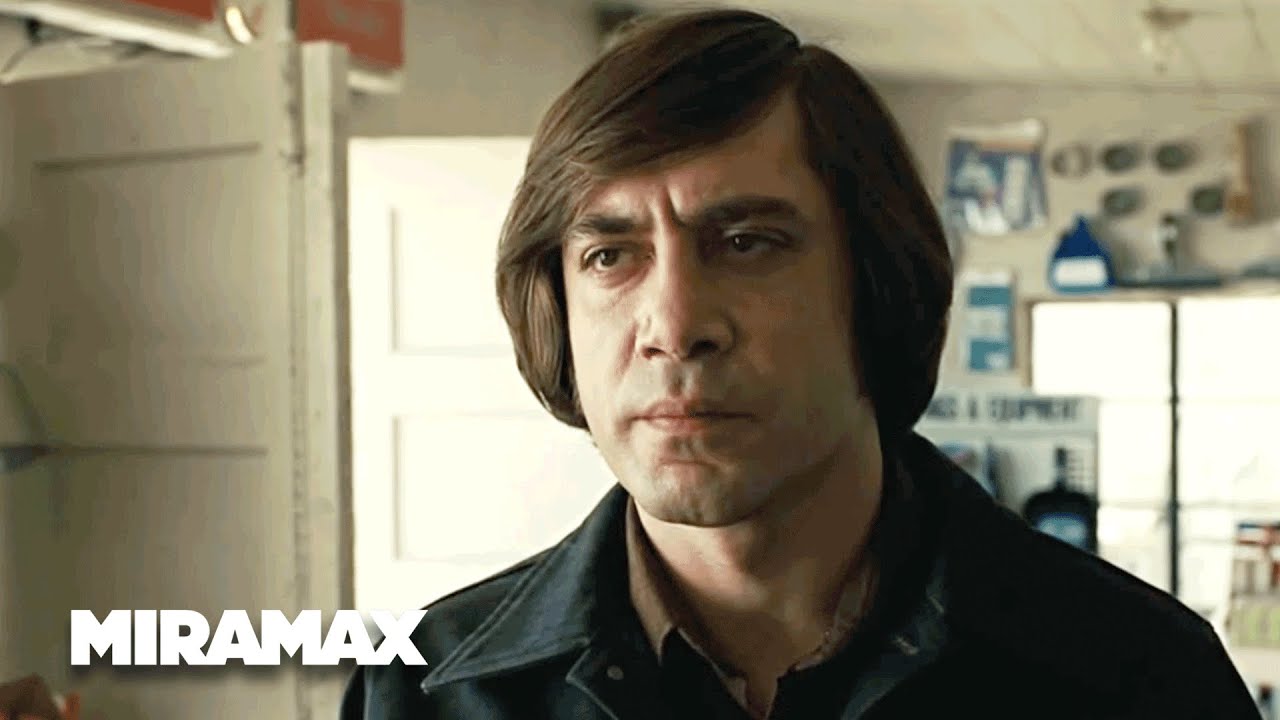
Today in class we finished watching No Country for Old Men. We continued to analyze elements of mise-en-scene and how they affect narrative aspects, and the four sentences of analysis based off of the movie are due tonight by midnight on Google Classroom. With all of the characters interacting and more of them becoming aware of Anton, there were plenty of mise-en-scene elements apparent and it was more evident as to how they affected the narrative aspects of the film. Today, I focused specifically on the eye-level shot angles on the two men in the diner following the shocking death of one of the characters, as the shot angles intensified the mood and tone. The overall tone of the film changed following the death of the character, and the rest of the film offered answers to the questions their death raised. The answers, however, may not be the ones that people were hoping to find out, considering the unorthodox ending the film had. I recommend that you watch it soon if you have not because it is unexpected, but well portrayed and surprising to some extent.

The shot angles in the film reminded my of Silence of the Lambs, a film I recently watched for the first time. There is a specific scene in that film when FBI agent Clarice Starling first meets psychologist and cereal killer, Hannibal Lecter, in which an eye-level shot angle is used. This specific shot, similar to No Country for Old Men, changed the tone of the scene. With the camera looking directly into Lecter’s eyes as he tells her to come closer, a sinister, chilling tone is established, intensifying the already established creepy tone. Although the tones of the two movies varied, the eye-level shots that were used in both changed and intensified the tones of their respective scenes, as well as the overall tone of the films. Both films exemplify how the shot angles chosen by producers can affect narrative elements, and as a result, further show us how mise-en-scene elements and narrative elements compliment and accentuate one another.

eye-level shot angle of Hannibal Lecter  

Wednesday, September 27, 2017

Kayla Edwards daily Blog 9/27/17 per5

Today in class we continued watching No Country for Old Men. We started watching at the scene where Chigurh is chasing Moss out of the hotel. Moss gets shot but manages to shoot Chigurh in the knee and he then disappears. I chose to do my MES analysis during this scene. I chose specifically a scene where Moss is hiding behind the corner of the building. The camera is tight on his face and the lighting is dark since it’s night time. I said that this creates suspense and creates tension because nothing can be seen around him and it is unknown where the shots being fired are coming from. After this, in the movie Chigurh escapes and so does Moss with the money. Moss pays a group of men on the street for their jacket and beer to cover himself up since he is covered in blood from being shot in the stomach. He throws the brief case of money off the bridge into the grass along a river. He then falls asleep on the ground. Moss meanwhile, blows up a car to create a diversion to steal drugs from a pharmacy. He uses the drugs to numb his knee which he then operates on to pull out bullet fragments. Moss wakes up in the hospital with a visitor. Carson Wells tells him to give him the money and leave it be because he doesn’t know who he’s messing with (Chigurh). Moss refuses however and still wants to keep the money. Wells retraces moss’s steps and ends up finding the briefcase but doesn’t go to take it. Chigurh finds Wells and brings him to a hotel room and ends up shooting him in order to find out where the money is. Moss calls Wells after he is shot and Chigurh answers and they then have a conversation about the money and what will happen to Moss. Moss leaves the hospital and gets clothes and then goes and retrieved the brief case. Meanwhile he calls his wife and her mother and tells them to meet him at the airport. The wife and mother are on there way but are followed but some Spanish men who I assume are involved with the money and drugs. Also, moss’s wife calls the sheriff to tell him she will give up Moss’s head if it means his safety. That is about where we ended today. 
While watching the movie I was really annoyed because the actor playing Carson Wells looked really familiar so I looked him up. Woody Harrelson is the actors name and he also plays in The Hunger Games series as Haymitch which is where I know him from. Some other films you may know him from are Now You See Me, War for the Planet of the Apes, Zombieland and Friends with Benefits. 
Woody Harrelson
MES analysis