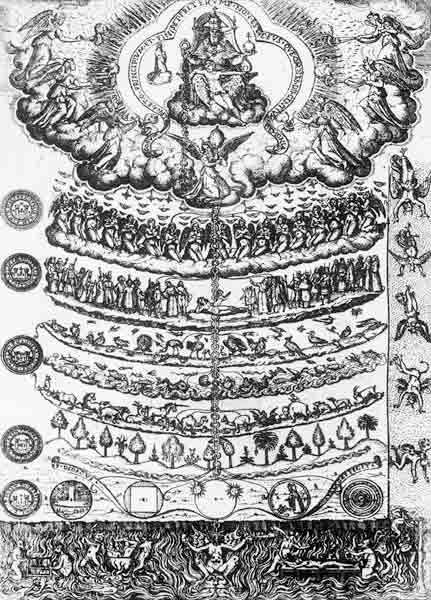
The first thing that came to my mind was Dante's Inferno. I thought of the seven circles of hell which looks very similar to this image. I also thought of the movie Inferno with Tom Hanks and I recommend watching it if you haven't yet.

However, I was indubitably deceived when Mr. Rivers told us what the picture really is of. It depicts The Great Chain of Being, a hierarchical structure of all matter and life created in 1579. The top of the chain shows God and below him are angels surrounding him. The chain then goes down to man, animals, plants, minerals, and at the bottom you see what is presumably hell. This was how people viewed the world around them and Christianity was predominant. Back in the medieval time period, the Great Chain of Being represented order and cosmos. The bottom represents chaos and depicts demons and flames everywhere. Each group in class then thought of themes that apply to the Great Chain. I said, "Those who rule are still susceptible to defeat". If you look to the right side of the drawing, you can see five angels falling from the top (heaven) to the bottom (hell). This is what inspired the theme that I thought of. Whether the angels are being sent to hell or to rejoin the ranks of men, it shows they aren't perfect either. After discussing the Great Chain of Being, we began reading a short story written by BJ Novak, one of the writers from The Office. The story we read was about a principal who decided to remove math from his school's curriculum to ultimately make the student body happier. In the end, he was fired and learning math became mandatory but the principal moved to Florida and bought a house on the beach. The theme for this story that my table formed was "Cosmos/order can be disrupted without severe consequences".
The topics we learned in class today have a great number of real world applications. The most important connection to make is to the realm of comedy. As time went on, writers and comedians have criticized the Great Chain of Being. Inciting chaos and disrupting cosmos is a classic method of disavowing the way of thinking in medieval times and beyond.

No comments:
Post a Comment